
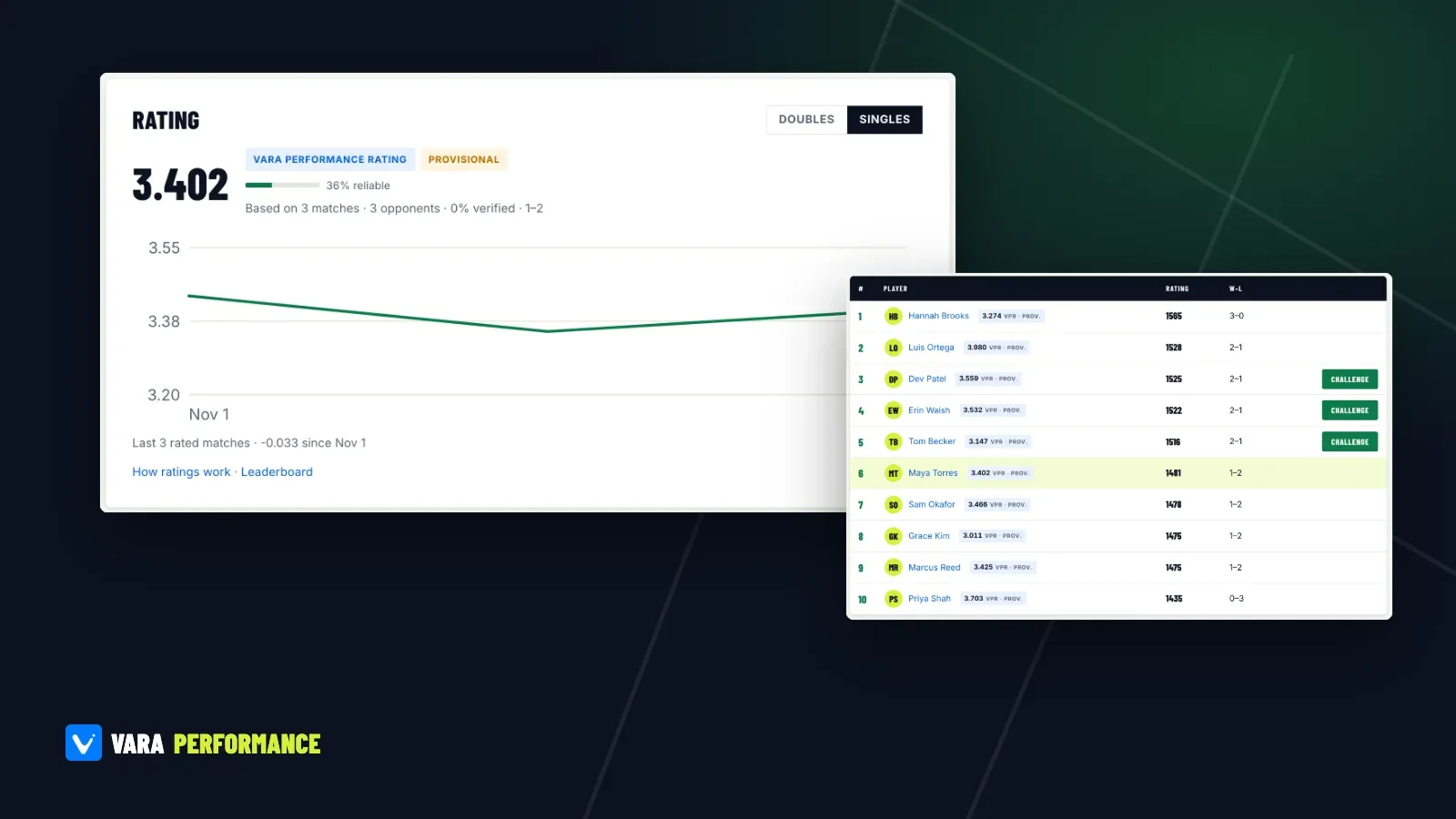
Every player wants to know roughly where they stand. Ratings answer that, but most rating systems are explained either in one vague sentence or in a page of math. This is the version in between: what the Vara Performance Rating is, what makes it go up and down, and what the labels next to it mean.
The full details, including the FAQ, are on How the Vara Performance Rating works. This post follows that page and doesn't add anything to it.
What the VPR is
The Vara Performance Rating (VPR) is a skill rating calculated from match results. You get one for doubles and one for singles, on the 2.000 to 8.000 scale pickleball players already know. It's free, and it's your headline rating everywhere on Vara Performance: your profile, player cards and the leaderboard.
It's built from confirmed matches: confirmed ladder matches today, plus results reported by partner clubs and recorded open play as those arrive. Every result goes into one ledger, and your rating is what that ledger says about you.
It's separate from ladder standings. A ladder has its own rating that only ranks the players on that ladder. Your VPR follows you across every ladder and club.
What moves it
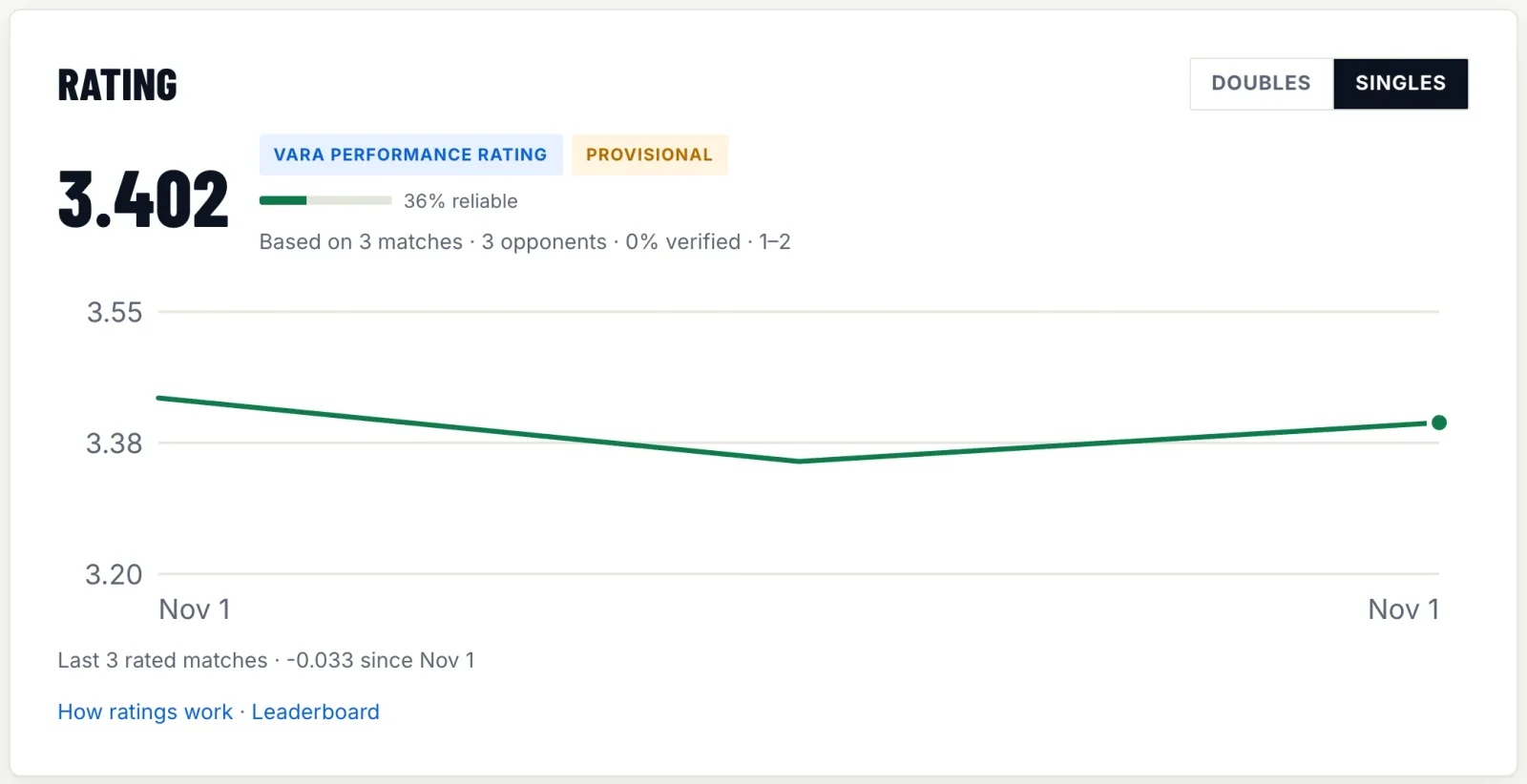
Your VPR is really two numbers working together: an estimate of your level, and how sure we are of it. Every confirmed match updates both, in the order the matches were played.
1. Every match has an expected result. Before a match, the ratings say how likely each side is to win. Between players whose ratings are settled, half a point apart is about a 76/24 favorite, and a full point apart is about 91/9.
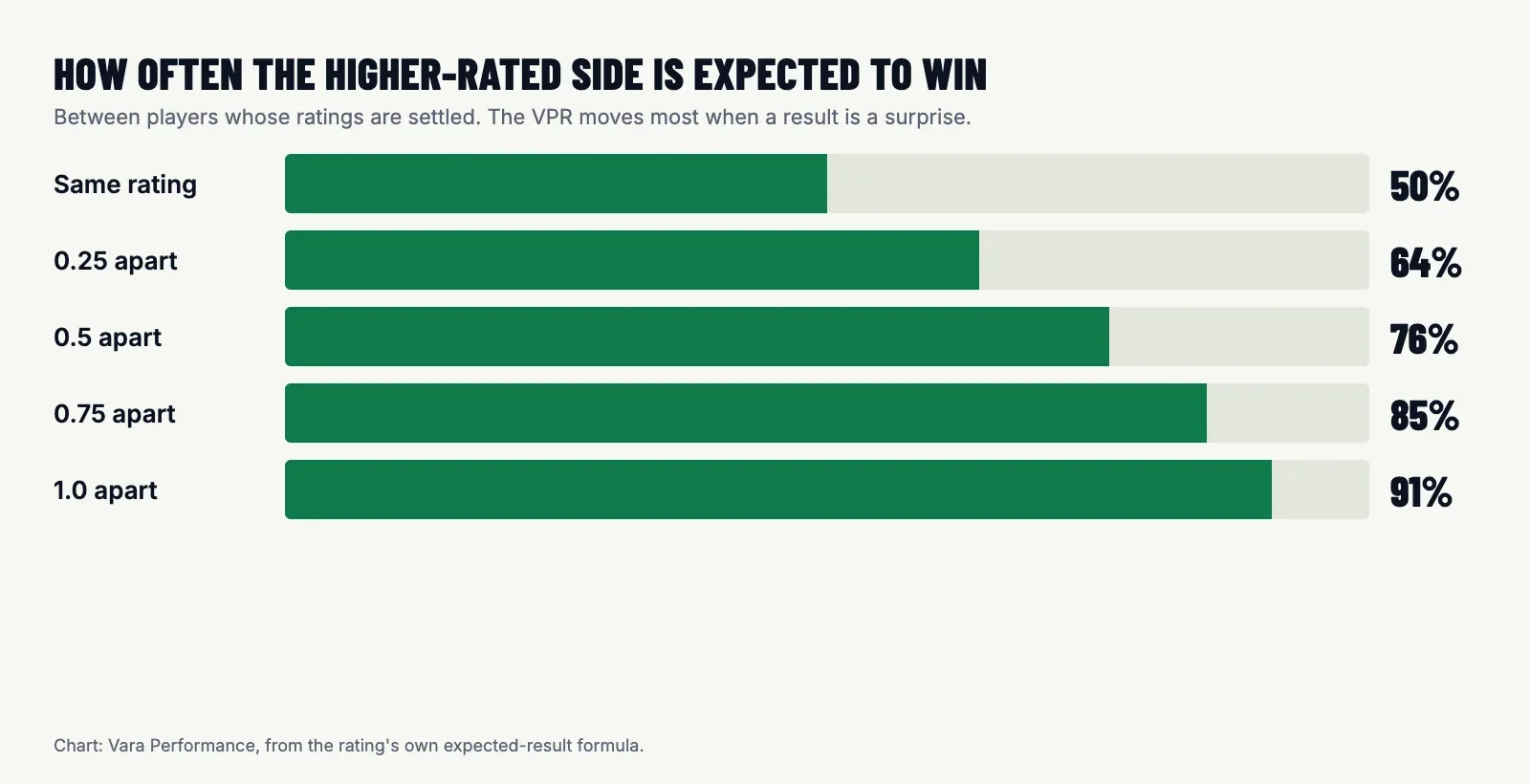
2. Surprises move ratings. Win when you were expected to lose and you gain a lot. Win as the favorite and you gain a little. Losses work the same way in reverse. That's why beating someone rated well below you barely moves your number: the result was expected, so it doesn't tell us much.
3. The margin counts, a little. An 11-2 game says more than 11-9, so a lopsided result counts for more, up to 1.25 times as much. It's a small effect on purpose: running up the score isn't worth much.
4. Certainty sets the pace. While we're still learning your level (you're new, or back after a long break), your rating moves quickly. Once your results are consistent, it settles, so one off day doesn't undo a season.
5. Doubles is shared, but not equally. A team's strength is the average of its two players. After a match, each partner moves by how much the result tells us about them, so the partner we know less about moves more.
When a result is reviewed, corrected or removed, ratings are recalculated from scratch in the order matches were played, for everyone in that match and anyone who played them afterwards. That's why your rating can change slightly on a day you didn't play.
Keeping it honest
A rating is only useful if everyone's is earned the same way. A few rules apply to every result:
- Verified results count most. Results entered by an organizer count fully, then rated round robins, then ladder results your opponent confirmed. Ladder results still count toward your rating, just a little less.
- Real games only. Every game needs a clear winner who scored at least 6. Anything else isn't rated.
- Same faces, smaller steps. Playing the same opponents again and again counts less each time, and there's a limit to how much rating anyone can gain from the same opponent.
- New accounts can't prop each other up. Results against players without an established record move established players less.
- A second look. Results that look out of the ordinary may wait for review before they count, and our team can remove a result that wasn't genuine.
We don't publish the exact thresholds. If you play real matches, none of this will ever get in your way.
Reliable, provisional and verified
Next to your rating you'll see a few labels. Here's what each one means.
Reliability (0 to 100%). How much your rating can be trusted. Most of it comes from how certain your rating is from your results. The rest comes from how recently you played (it starts to fade after a month without matches, down to nothing after a year) and how many different opponents you've faced (six or more for full credit). Results against a range of players, and verified ones, raise it faster than a long run against the same two people.
Provisional. Your rating is provisional until you've played 5 rated matches and reached 40% reliability. Most players get there in 6 to 10 matches against a few different opponents.
Verified share. Your profile shows what your rating is built on: how many matches, how many different opponents, and how much of it is verified. A result is verified when an organizer entered it (a league or tournament) or it came from a rated round robin.
The leaderboard rule
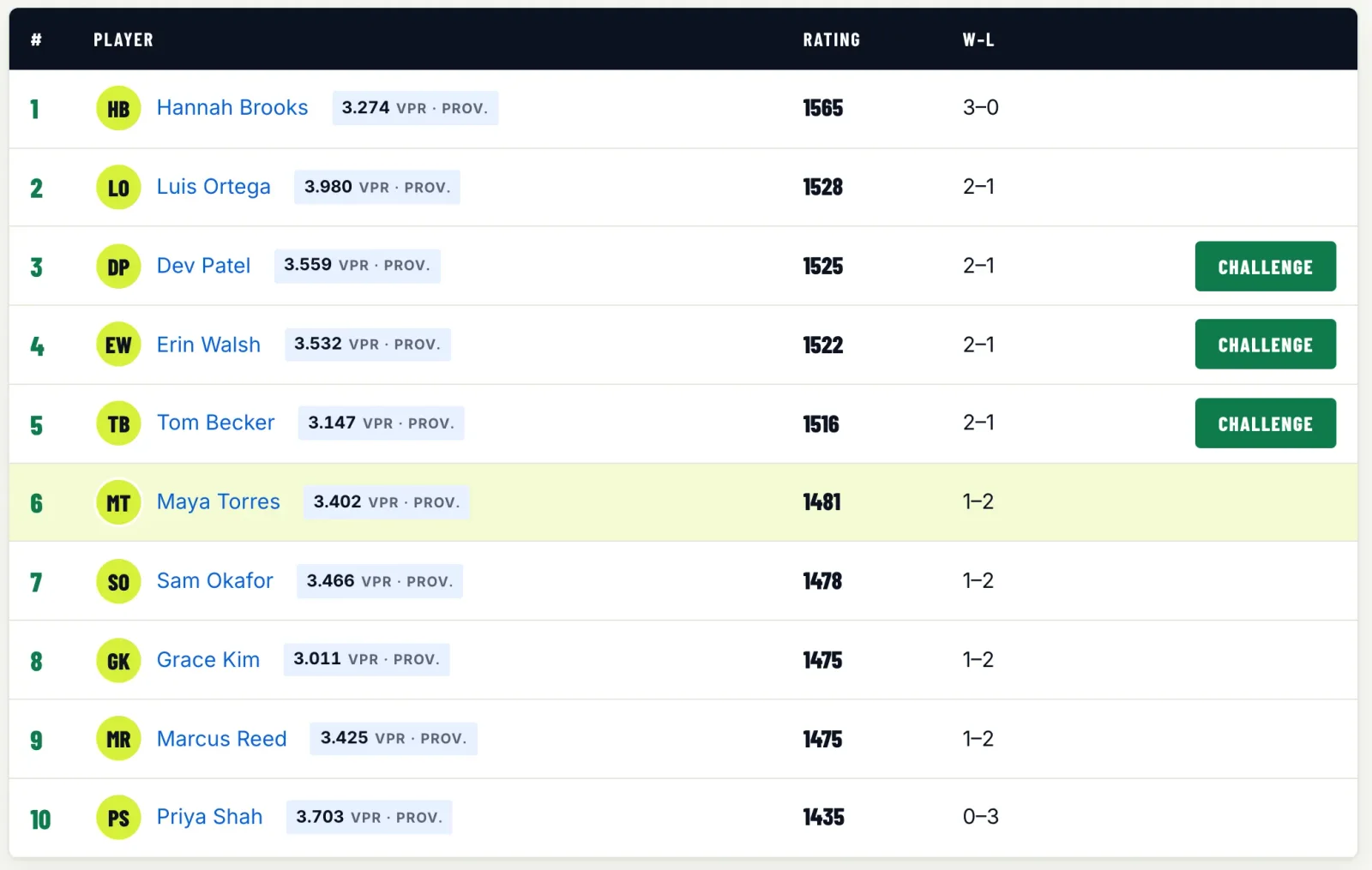
The leaderboard lists players whose rating is at least 40% reliable and rests at least 30% on verified results. For that verified share, a ladder result your opponent confirmed counts half.
In practice, a player who has only played ladder matches needs some organized results too (a league, or a rated round robin) to appear. If you'd rather not be listed at all, you can stay off leaderboards in your privacy settings.
Where you start
Before your first match, we need a starting point. In order of preference:
- Your connected DUPR rating (verified), once DUPR connection launches.
- A DUPR rating you typed in yourself (self-reported, unverified and private, counted up to 4.000).
- Your self-rated skill level from your profile (also counted up to 4.000).
- Otherwise, 3.000.
The starting point is a guess, and the results are evidence, so matches take over quickly. If you started from a level you typed in, your rating stays provisional until you've played 5 matches against players with an established record.
Where DUPR fits
DUPR uses the same 2.000 to 8.000 scale, which is why the numbers feel familiar. But the VPR is calculated by Vara Performance from matches recorded here, and the two are separate ratings.
VPR first. Your VPR is always your headline rating. Connecting DUPR is coming soon. Once it launches, your verified DUPR rating will show as a badge next to your VPR, never in its place.
Self-reported DUPR stays private. A DUPR rating you type in yourself is used only to set your starting rating (up to 4.000). It never shows on your public profile.
Lined up later. Once enough players have both a VPR and a connected DUPR rating, we'll line the VPR scale up with DUPR's, so a VPR reads like the DUPR number you'd expect. Until then, the two are calculated independently.
Sending results to DUPR depends on DUPR's approval. Once DUPR connection launches and DUPR approves our club-organizer setup, matches where every player has connected DUPR and the scores meet DUPR's rules can be sent to DUPR. Until then, matches here don't count on DUPR.
If a result is wrong
Dispute it before it's confirmed:
- Ladder match: tap Dispute in My matches before the confirm deadline, and our team reviews it.
- Round robin: dispute the score and the organizer decides. Organizers can correct any score.
- Club league: dispute the fixture result and our team reviews it.
If a result is already confirmed, or it's anything else, contact us from the ratings page. Ratings are recalculated as soon as a result is corrected or removed.
Getting your first rating
The quickest way is to join a ladder, play, and report the score. Your rating appears after your first confirmed match. To see how you compare, check the leaderboard, and to manage your starting level, go to your rating settings.