
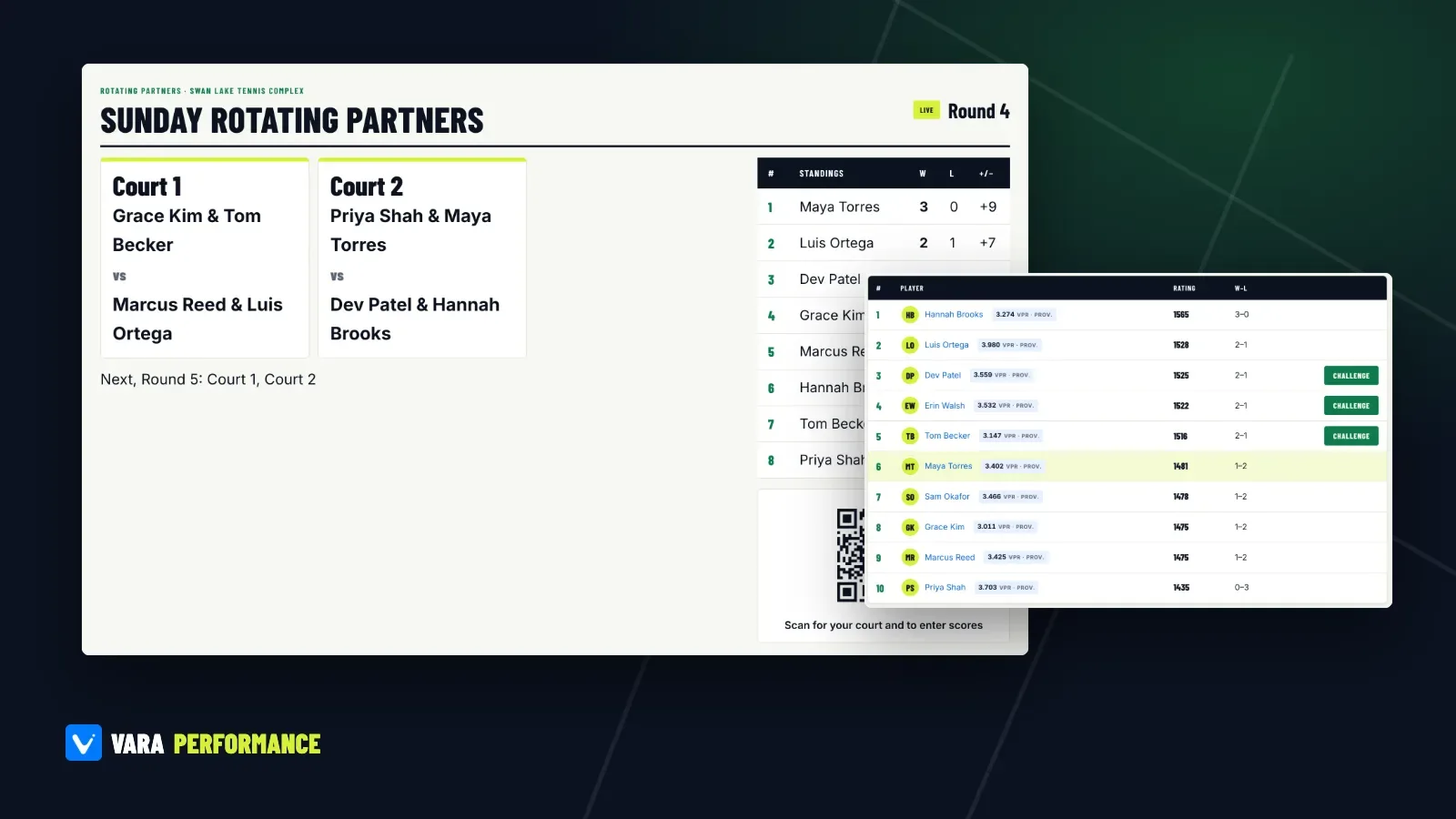
Once you've played a few times, you start to notice that "playing pickleball" covers very different things. Some people drop in whenever they're free. Some want a structured afternoon with standings. Some want a match every week against people near their level, with something on the line.
There's no right answer, but there is a right answer for you this season. Here are the four main formats, what each one asks of you, and what you get back.
At a glance
| Open play | Round robin | Ladder | League | |
|---|---|---|---|---|
| Commitment | None. Drop in. | One session | A season, at your pace | A season, set nights |
| Partners | Whoever is next | Rotating, or fixed | Singles, or a fixed team of two | Your team |
| Scores kept? | Usually not | Yes, with standings | Yes, reported and confirmed | Yes, by captains |
| Counts toward your rating? | Only in a rated live queue | Only rated sessions | Yes | Yes |
| Best for | New players, social play | A structured afternoon | Steady, competitive matches | Team players |
Open play: drop in, play, leave
Open play is time set aside at a court or gym for drop-in doubles. You put your paddle in line, play a game with whoever is up next, and rotate off. Nobody keeps standings, and nobody minds if you leave after an hour.
Choose it if you're new, your schedule is unpredictable, or you mostly want to play a lot of games with a lot of different people.
What to watch for: level mix. A session open to everyone can mean lopsided games. Look for sessions with a level range, or check how many people are going and at what level before you go. Open play near you shows both. Our guide to your first open play covers how sessions run.
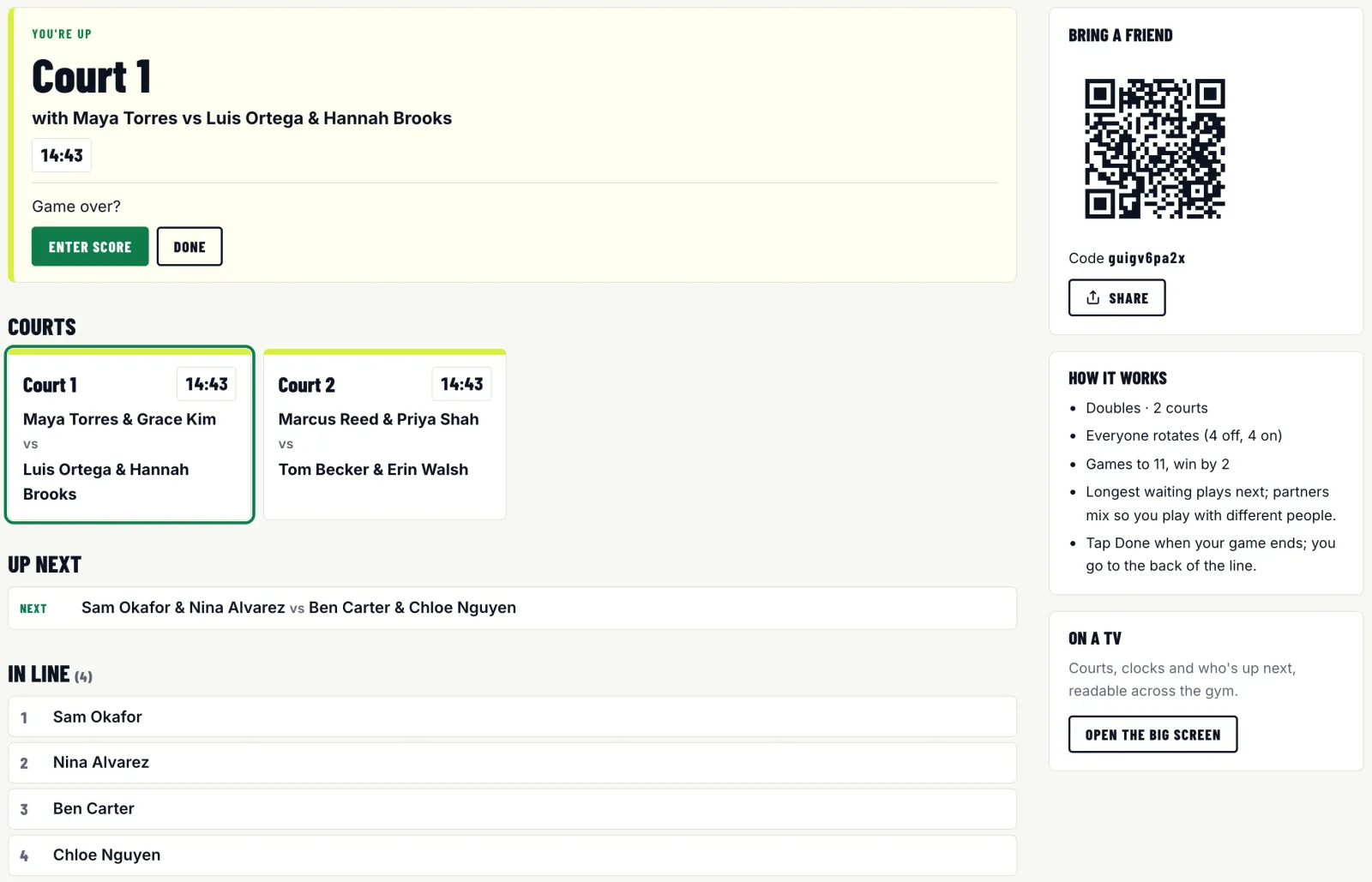
Busy sessions often use a live queue instead of a paddle rack. The host starts it on Vara Performance, players join from a link or QR code, and the longest-waiting players go on next with partners mixed up. You see which court you're on and who you're playing. A host can also make a queue rated, in which case it works like a rated round robin: each player is asked to accept, and only games where every player accepted count.
Round robins: open play with a schedule
A round robin takes the social part of open play and adds structure. The organizer sets the format, courts and scoring; the schedule tells everyone who they play with, against whom, and on which court, round by round. At the end there are standings.
There are a lot of formats under the name. On Vara Performance an organizer can choose from 11, including rotating partners, mixer (popcorn), skill-balanced rotation, mixed doubles rotation, Up and Down the River, Swiss, fixed-partner round robin, and pool play into a bracket. Up to 64 players can take part in one session.
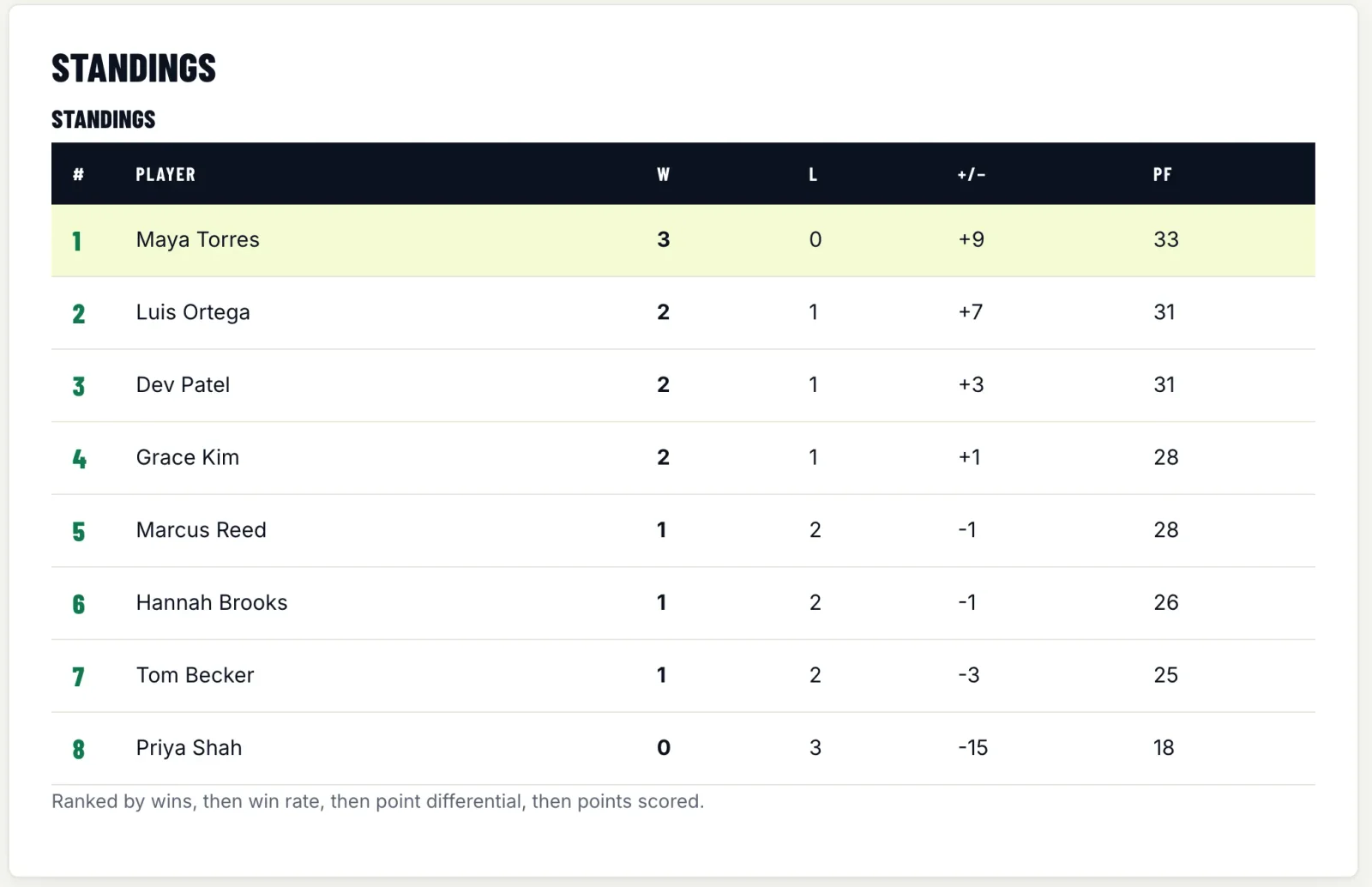
Players enter their own scores from their phones. The other side confirms, or the score stands after a few minutes if the organizer set it up that way. If the two sides enter different scores, the organizer decides. Standings rank by wins, then win rate, then point difference, then points scored.
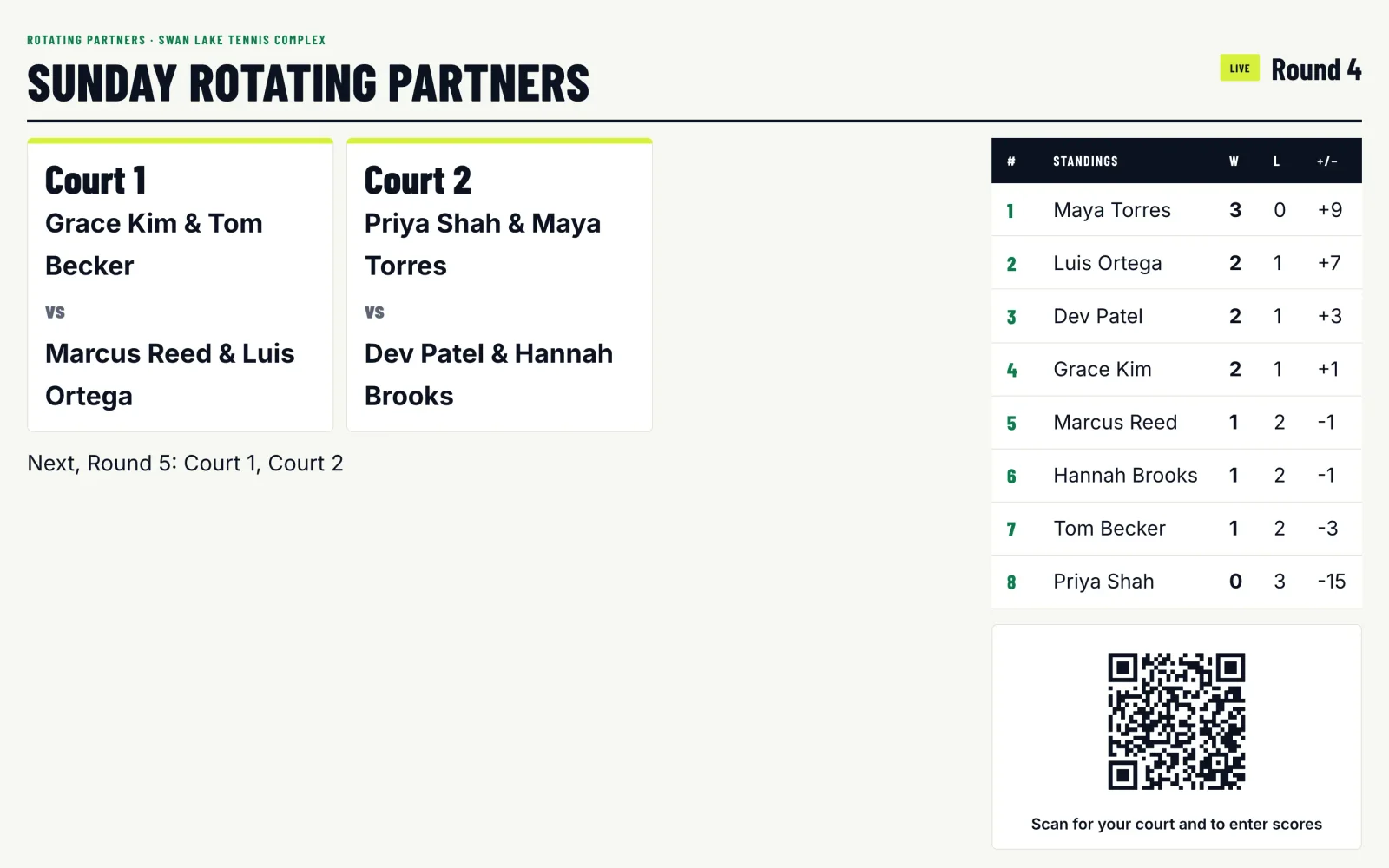
For a gym or a big group, the organizer can put the Big screen on a TV. It shows the current round's courts, who's sitting out, who's next, the top of the standings, and a QR code players scan to see their court and enter scores.
Choose it if you like open play but want every game to count for something, or you're organizing and want courts assigned for you.
About ratings: round robins are unrated by default. An organizer can turn on Rated session; each registered player is then asked to accept, and only matches where every player accepted count toward the Vara Performance Rating. Guests are never rated.
Find one under "Round robins you can join" on Open play near you, or run your own.
Ladders: steady matches, at your own pace
A ladder is a ranked list of players (or teams of two, for doubles). You climb by challenging someone above you and winning. There's no fixed schedule: you arrange each match with your opponent, play it when it suits you both, and report the score.
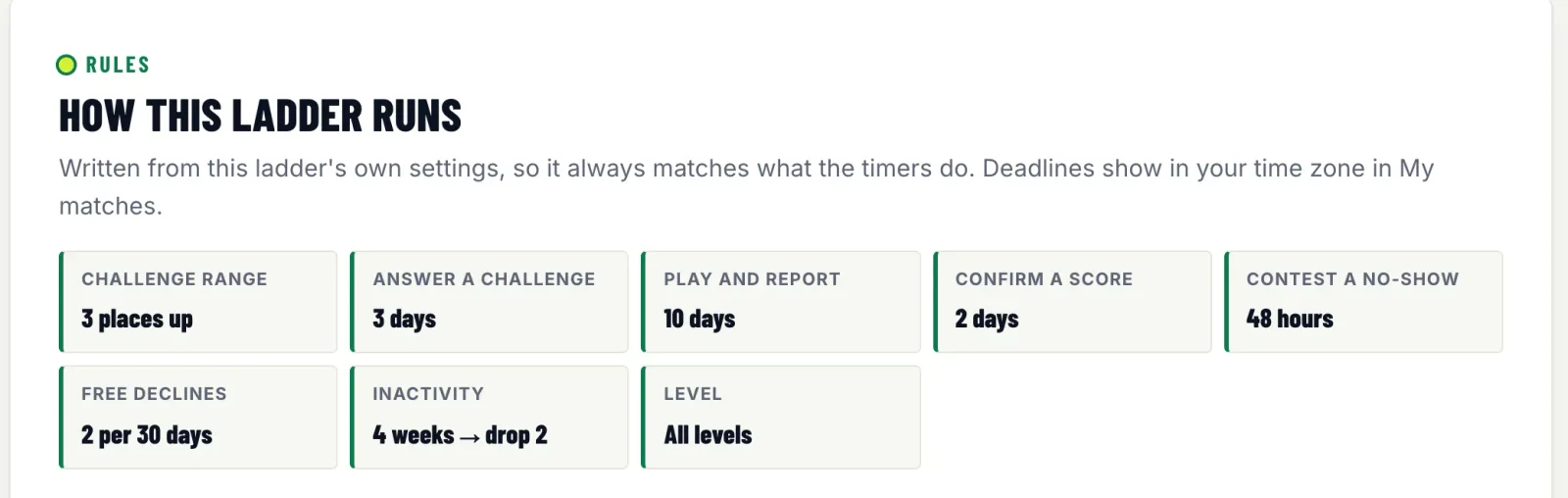
The default rules on Vara Performance, which each ladder can change and always shows on its page:
- Challenge anyone up to 3 places above you.
- They have 3 days to accept or decline. Two free declines every 30 days; after that, a decline counts as a forfeit.
- Play and report within 10 days.
- Either side reports the score; the other has 2 days to confirm or dispute it, or it confirms itself.
- Four weeks without a match drops you 2 places.
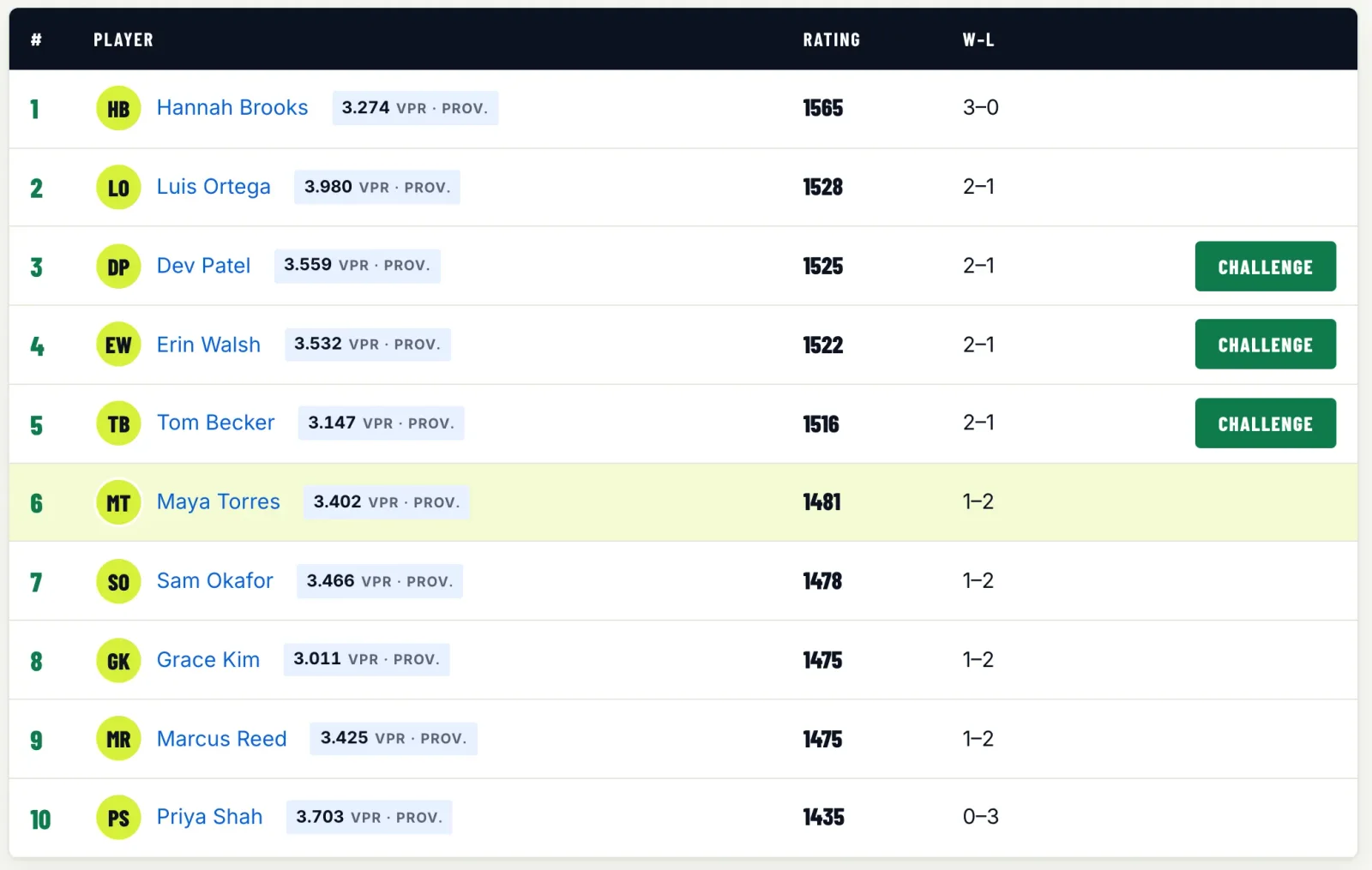
The ladder's own rating only ranks its players. Every confirmed match also counts toward your Vara Performance Rating, which follows you across every ladder and club. Ladders run in seasons (12 weeks by default); at the end, the standings are archived and the top 3 earn a profile badge.
Choose it if you want regular competitive matches but can't commit to the same night every week, or you play singles.
Browse ladders near you in Ladders and leagues.
Leagues: a team, a night, a season
A club league is the most structured option. It has set nights, a schedule of fixtures week by week, teams (or individual players, depending on the league), standings and sometimes playoffs. Leagues are run by partner clubs and venues, and you register to join; if a league is full, there's a waitlist.
After each match, a captain reports the score and the other captain confirms or disputes it. Final results update the standings and count toward everyone's rating. You get a reminder the day before each match.
Choose it if you like playing with the same partners, you can commit to a night a week, and you want the feeling of a season.
See what's running in Club leagues.
How to choose
A few questions settle it for most people:
- Can you commit to a fixed night? If not, open play or a ladder.
- Do you want your results to count? If yes, a ladder, a league or a rated round robin.
- Do you mostly want to meet people? Open play and rotating-partner round robins mix you with the most players.
- Are you organizing? A round robin or a live queue takes the scheduling off your hands, and both are free.
Plenty of players do more than one: open play during the week, a ladder match when it fits, and a round robin on a Sunday. Start with whichever sounds most fun, and find something to play this week.