
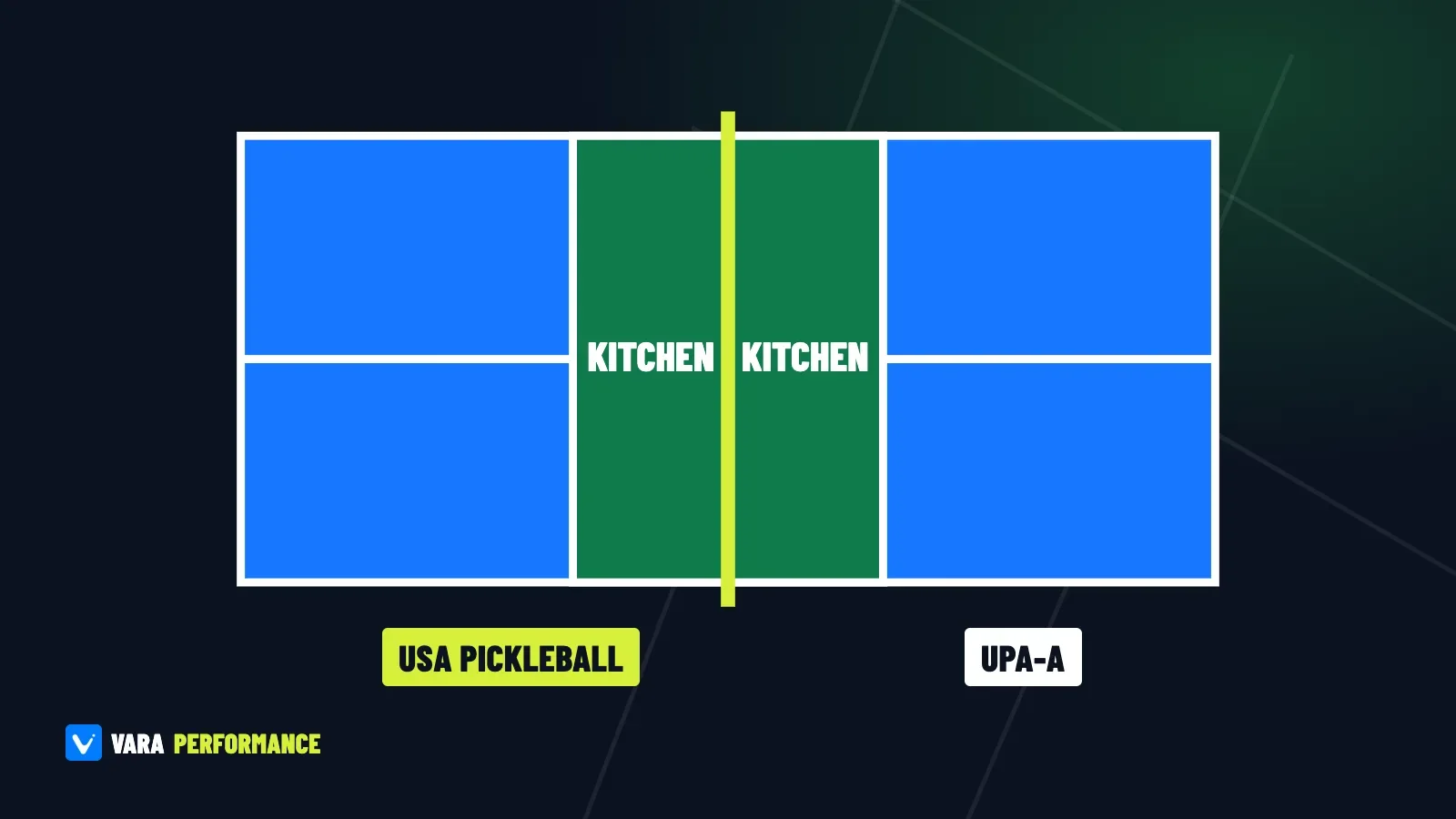
If you play pickleball in the US, two rulebooks are worth knowing about. USA Pickleball's Official Rulebook is the one most players learn from. The UPA-A Rulebook is written by the United Pickleball Association of America for the events it sanctions, which include the PPA Tour and Major League Pickleball.
For a Tuesday night at the park, you don't need to know either one cover to cover. But some differences come up in rec play, especially when someone has been watching pro matches and brings a habit back to the courts. This post covers those, with the section number from each book so you can check for yourself.
Everything here comes from our rulebook summaries, which are written in our own words from the 2026 USA Pickleball Official Rulebook and the UPA-A Rulebook and Principles 2026-2027 (Version 0.9, printed August 24, 2026). They're summaries. The official rulebook governs, and the links to both are on that page.
Which rulebook applies to your game?
USA Pickleball says Parts I and II of its rulebook apply to all play: recreational, social, league and tournament. Part III adds rules for USA Pickleball sanctioned tournaments. Non-sanctioned tournaments may use it as a guideline, and USA Pickleball recommends they do (Front matter, pp. ii-iii).
UPA-A rules apply to amateur and pro matches at UPA-A sanctioned events (1.2.1). Non-sanctioned events may adopt it if the organizer chooses (1.1).
So for most open play, rec leagues and casual games, USA Pickleball's rules are the usual reference unless your group or event says otherwise. If you're entering a tournament, check which rulebook it plays under.
Most of the game is the same
Before the differences, it helps to know how much is shared. Under both books:
- The court is 20 by 44 feet, with a 7-foot non-volley zone (the kitchen) on each side, and the kitchen lines count as part of it (USAP 3.A.1, 3.A.4.c; UPA-A 3.1.1).
- The net is 36 inches high at the sidelines and 34 inches at the center (USAP 3.B.6, 3.B.7; UPA-A 3.1.2).
- Scoring is side-out by default: only the serving side scores (USAP 4.A; UPA-A 5.6). Doubles scores are called as three numbers, starting at 0-0-2 (USAP 6.B.2; UPA-A 5.2.1).
- The serve and the return must each bounce before being hit (USAP 10.A; UPA-A 8.1).
- You call a ball out only when you clearly see space between it and the line, and when partners disagree, it's in (USAP 8.E, 8.H; UPA-A 7.1, 7.2).
- A serve that lands on the kitchen line is out (USAP 8.C; UPA-A 7.3).
If you know those, you know most of what you need under either book.
Serving: the drop serve
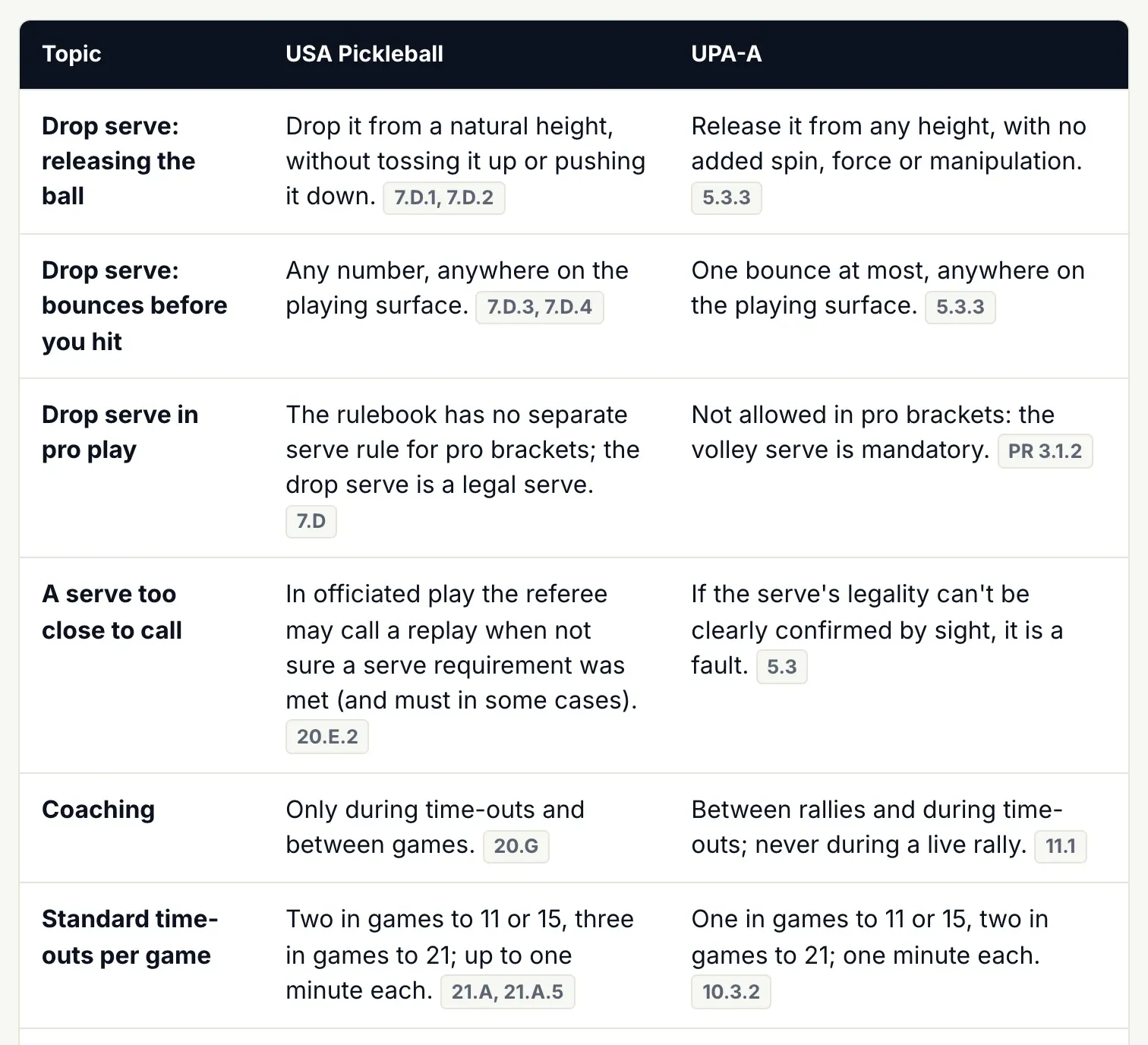
The drop serve, where you let the ball fall and hit it after it bounces, is where the books differ most for everyday players.
- Releasing the ball. USA Pickleball: drop it from a natural height, without tossing it up or pushing it down (7.D.1, 7.D.2). UPA-A: release it from any height, with no added spin, force or manipulation (5.3.3).
- Bounces before you hit. USA Pickleball: any number, anywhere on the playing surface (7.D.3, 7.D.4). UPA-A: one bounce at most (5.3.3).
- In pro play. UPA-A doesn't allow the drop serve in pro brackets; the volley serve is mandatory (PR 3.1.2). USA Pickleball has no separate pro serve rule (7.D).
For most rec players this changes nothing: drop the ball from about where you'd normally hold it, let it bounce once, and hit it. That's legal under both.
The kitchen and the net
Two differences here come up in fast exchanges at the net.
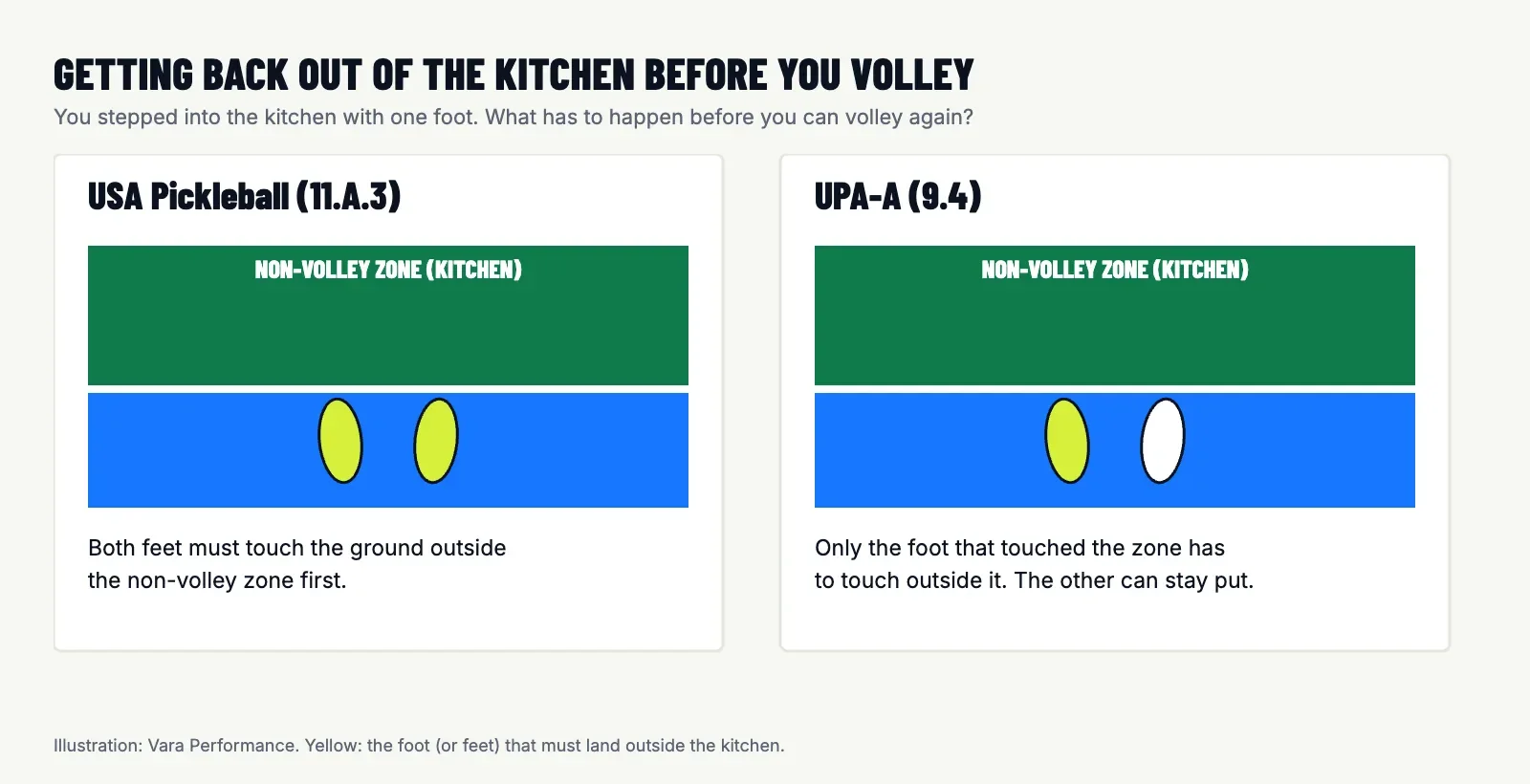
Getting back out of the kitchen before a volley. If you step into the kitchen, you have to get back out before you can volley. USA Pickleball says both feet must touch the ground outside the non-volley zone (11.A.3). UPA-A says each foot that touched the zone must touch outside it, so if only one foot went in, only that one has to (9.4).
Reaching over the net. Under USA Pickleball, it's a fault if you, or anything you wear or carry, crosses the plane of the net before you hit the ball (13.I, 13.I.1.a). Under UPA-A, it's a plane-of-the-net fault only if your body completely crosses before you hit; reaching your paddle across is not one, though it can still count as a distraction (8.3.1).
Portable nets and broken balls
These are the most "rec" rules of all, because they come up at parks and gyms with temporary setups.
The ball hits a portable net's crossbar after bouncing. USA Pickleball: replay the rally (13.B.2). UPA-A: the player who hit it over wins the rally, and it's a replay only if it hits the bar before landing (8.2).
A cracked ball. USA Pickleball: replay if all players agree (or the referee decides) that a broken or cracked ball affected the rally (10.G.1, 20.F.1). UPA-A: replay only if the crack runs from one hole to another or the ball splits in two (6.7).
Calling faults when there's no referee
Almost all rec play has no referee, so these matter more than they seem.
- Calling an opponent's fault. USA Pickleball lets you call kitchen faults and service foot faults on an opponent; if the teams disagree, you replay the rally (9.B.3, 9.B.3.b). Under UPA-A, you can raise any suspected fault, but only the player accused can enforce it, and if they don't agree, the rally stands (15.3).
- Hinders. USA Pickleball: any player may call one, and the rally is replayed (9.C.1, 9.C.2). UPA-A: replayed only if all players agree; otherwise the rally stands (15.4).
- Asking your opponent about a line call. Under both books, their clear call stands. USA Pickleball allows it to be overruled by a referee on appeal (8.I, 19.D.2); UPA-A says it can't then be appealed (7.6).
The habit that works under both: if you aren't sure, the ball is in, and if a call is disputed in a friendly game, replaying the point keeps everyone happy.
Other differences you might notice
- Changing ends. USA Pickleball only changes ends mid-game in single-game matches and in the deciding game of a match (21.B). UPA-A changes ends at the midpoint of a game in every match format (4.4.1).
- Time-outs. USA Pickleball allows two per game in games to 11 or 15 and three in games to 21, up to a minute each (21.A, 21.A.5). UPA-A allows one per game in games to 11 or 15, two in games to 21 (10.3.2).
- Rally scoring. USA Pickleball has it as a provisional option for singles and doubles (14.A, 15.C.2). Under UPA-A, a Tournament Director may allow it for singles, and its appendix is marked In Progress in version 0.9 (TO 2.3; Appendix E).
- Paddles. For USA Pickleball sanctioned play, your paddle must be on its Approved Paddle List (3.D.1, 18.A). UPA-A encourages a paddle on its own list and permits one on USA Pickleball's (3.2.2).
- Earbuds. USA Pickleball: no headphones, earbuds or audio devices while playing, except hearing aids (18.D). UPA-A: no headphones, earbuds or audio calls; texting is allowed during a break in play (11.4).
There are more, mostly about tournaments: penalties, medical time-outs, coaching, arriving late and what happens when a doubles partner retires. The full comparison has all of them.
Where to go from here
- New to the game? Start with the 10-minute guide to the rules, then read the USA Pickleball summary.
- Playing a UPA-A event? Read the UPA-A summary and the official rulebook it links to.
- Settling an argument at the courts? Look up the section number here, then check the official rulebook. Where our summary and the rulebook disagree, the rulebook wins.
Rules are easier to remember once you're playing them. Find open play near you and put them to use.